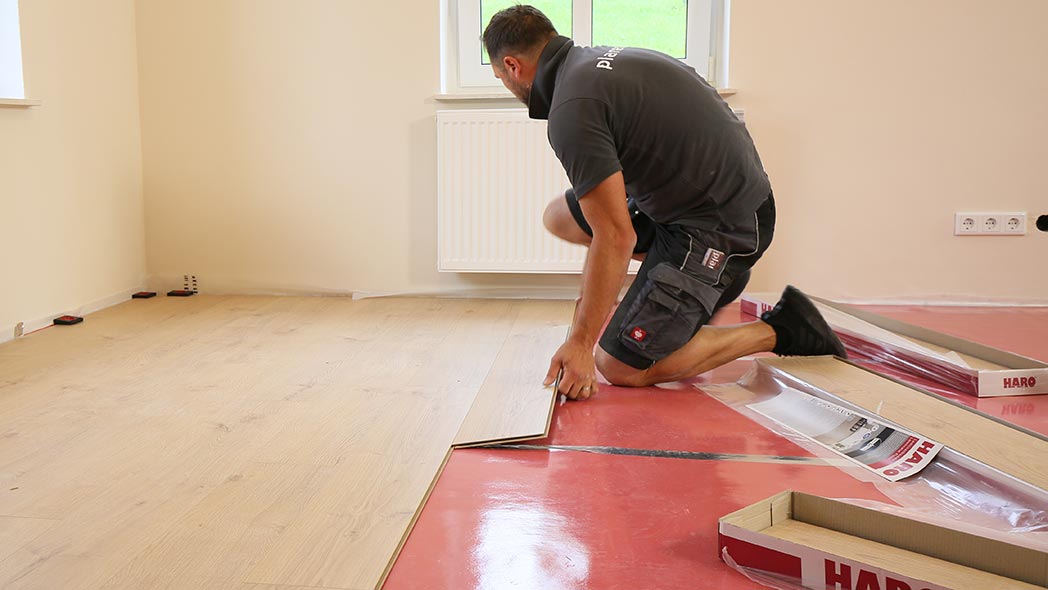
Lay vinyl flooring and avoid mistakes

 ca. 11 Min.
 0
0 26.07.2024
Vinyl flooring is durable, easy to maintain and available in many attractive colours and designs. It is an ideal floor covering for creating an appealing look quickly and at a relatively low cost. However, fully bonding vinyl flooring requires some previous DIY experience. Removing it again later can also be a real challenge. That is why click vinyl is one of the best inventions around. Hardly any floor covering is easier to lay. To help your project turn out perfectly, this article shows you how to avoid mistakes when laying vinyl flooring.
Avoid installation mistakes right from the start: choose the right vinyl flooring for your project from our extensive range – durable, easy to maintain and available in numerous stylish designs.
Content
- 1 Preparation is everything
- 2 The indoor climate matters
- 3 Keep footsteps quieter
- 4 Keep your distance: important for vinyl too
- 5 Do not build up too much height
- 6 Buy spacers
- 7 Lock or Drop Down?
- 8 Vinyl planks need to be staggered
- 9 When nothing can move any more
- 10 Joints without fixing the floor in place
- 11 Typical problems after installation: what to check
- 12 Read the instructions and do it properly
Preparation is everything
Vinyl is soft. Anyone who has ever touched the material knows that. This material property makes vinyl flooring very pleasant underfoot. On the other hand, every uneven area in the floor can show through on the vinyl surface. It is therefore essential to level the subfloor carefully before installation. The ideal base for laying vinyl flooring is dry, clean, firm and level. This means that click vinyl cannot be laid over carpet. Because carpet gives way under pressure, unattractive gaps could form between the vinyl planks over time. Take a close look at old tiled floors, timber floors and screeds as well. Installation is possible on these substrates, but if tiles or timber boards have sunk or the screed contains small holes, you will need to fill and level these uneven areas. For some vinyl floors, a maximum deviation of three millimetres over one metre may serve as a possible guideline. However, the requirements of the respective manufacturer and flooring system are decisive.
Take care with new screed
Why the caution? We have just said that the floor should be clean, firm and perfectly smooth. - A new screed gives you exactly these properties. But one characteristic is still missing: the subfloor must also be dry. There are guideline values for this that should be checked with a CM moisture meter. As a rule, cement screed may have a maximum residual moisture content of 2.0 CM %. For anhydrite screed, the usual limit is 0.5 CM %. With heated screeds, the corresponding guideline values are often 1.8 CM % and 0.3 CM % respectively. Always follow the requirements of the specific flooring, screed and heating system.
The indoor climate matters
The vinyl has arrived! Neatly packaged, together with suitable impact sound insulation. Your floor is prepared. The tools are ready and you can hardly wait to get started. But that would be a mistake. Think about the different climatic conditions the material has passed through. First a cool warehouse, then perhaps a lorry heated by the sun. Now it is in the climate of your home. As a conservative guideline, you can allow the vinyl to acclimatise for up to 48 hours in the rooms where it is to be installed. Depending on the product, however, manufacturers may specify shorter periods or different temperature and climate conditions. You should therefore follow the relevant installation instructions. Vinyl that has not been acclimatised, or has been acclimatised for too short a time, can develop gaps and distortions after installation.
Keep footsteps quieter
Whether you need additional impact sound insulation beneath your vinyl flooring depends on the product and the floor construction. Some vinyl planks already have underlay integrated into them. Other click vinyl floors are designed for use with a separate underlay. The manufacturer’s approval is therefore always decisive. An unsuitable underlay, or an additional underlay beneath a product that is not designed for one, can compress too much and place excessive strain on the click joints or impair the performance of the floor.
If the manufacturer offers a suitable underlay or specifies certain properties, you should follow these requirements. Do not simply buy a particularly soft foam, because an underlay that gives way too much can cause problems. Flooring underlay is available, for example, in rolls or boards. How it should be laid and which side should face upwards depends on the particular product.
Keep your distance: important for vinyl too
People often say that wood moves. Vinyl does too. Although the material is not naturally grown, its soft and flexible nature makes it sensitive to temperature fluctuations. When sunlight enters the room or temperatures become very high, it expands. That is not a problem, but it needs enough space to do so. You therefore need to leave a sufficient expansion gap around all fixed building elements. Five millimetres is a typical minimum value for some products, while other systems require larger perimeter gaps. The specific installation instructions are therefore decisive. If you forget this gap or make it too narrow, your new flooring may buckle as it warms up. This is particularly likely to happen beneath radiators.
Allow space in "internal areas" too
An expansion gap around the perimeter, along walls, around a kitchen island and around other obstacles makes sense. What is more often forgotten is that expansion joints may also be required within the vinyl surface itself. With some systems, a side length of eight to ten metres is already within the range where additional joints may be required. Other products allow larger uninterrupted areas. The exact guideline depends on the particular vinyl flooring and its installation instructions. If you lay your vinyl flooring over screed that contains a structural expansion joint, transfer this joint into the flooring in accordance with the system requirements.
Do not build up too much height
Doors that scrape or no longer close, together with wear marks on the vinyl caused by constant friction, can occur if you ignore the overall height of your new flooring. This consists of the thickness of the vinyl plank plus any additional impact sound insulation that may be required. Measure carefully or test whether anything catches or rubs. Minor problems can be compensated for by placing special washers on the door hinges to raise the door slightly.
Buy spacers
Lay the first and second rows of vinyl planks without spacers? - That is neither enjoyable nor likely to produce a good result. Firstly, many walls are not perfectly straight. Secondly, the first row you lay will keep moving if it does not have even resistance against the wall. You create this resistance by positioning spacers along the wall and aligning the first row of planks neatly against them. When clicking the second row into place, you can then apply the necessary force because the first row is supported by the spacers.
Lock or Drop Down?
There is no need to rely on your school English here, because these are technical terms. The English terms describe typical types of click connection used on vinyl planks. With some Lock systems, the elements are inserted into one another at an angle from above, while certain Drop Down systems are laid flat and then locked into place. There are also other locking systems, each with its own installation technique. Do not therefore try to close a click joint using a method that is not intended for the particular system. In the worst case, you may damage the connecting edges. The manufacturer’s installation instructions specify the correct technique.
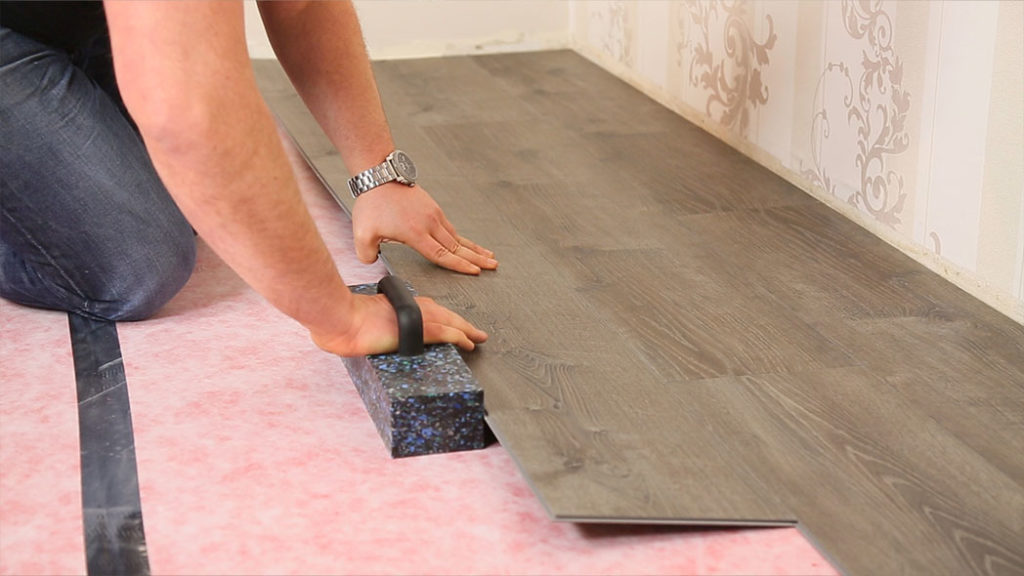
Vinyl planks need to be staggered
This does not mean, of course, that the gaps should be as wide as possible. Instead, the ends of the planks in the following row should be sufficiently offset from one another. An offset of at least 30 centimetres is a common guideline for many products, although this can vary depending on the plank format and manufacturer. Professionals also refer to this as the "stagger" between individual rows. If these joints lie too close together, sunlight, loads and heat can cause gaps to form in the floor.
When nothing can move any more
Lay the vinyl flooring first and then place an extremely heavy kitchen island on top of it? - Not a good idea. The heavy unit fixes the floor over a larger area while the surrounding vinyl continues to expand and contract. These differences in tension can lead to distortion and gaps. It is better to install the kitchen island first and lay the vinyl planks around it.
Joints without fixing the floor in place
At junctions in bathrooms or next to fixed building elements, an elastic seal may be required depending on the flooring system. The necessary freedom of movement of a floating vinyl floor must not be lost. A suitable PE backing rod can prevent the sealant from creating rigid three-sided adhesion between the vinyl, the fixed element and the subfloor. Whether and how such a joint may be sealed with silicone depends on the installation instructions and the particular floor construction.
Typical problems after installation: what to check
Important: the causes listed are possible points to investigate and do not constitute a definitive diagnosis. Before lifting or reworking individual planks, always check the manufacturer’s specific installation instructions.
Read the instructions and do it properly
This article has given you valuable guidance to help make your vinyl flooring project a professional-looking success. But your research should not end here. One point is particularly important: always read the installation instructions provided by the manufacturer of your vinyl flooring. Reputable manufacturers include these instructions with the properly packaged material. They are written clearly and provide all the guidance required for working in a way that is appropriate for the material.
If a defect is present despite correct installation, statutory warranty rights must generally be asserted against the seller. A commercial guarantee is different: it is an additional voluntary service offered by a manufacturer or seller and is governed by the relevant guarantee conditions. Failure to follow the installation instructions may be relevant when assessing damage or a guarantee claim, but it does not automatically result in the loss of all rights in every case. As is often true in life: those who can read (and act accordingly) have a clear advantage.
You may also be interested in these topics
Vinyl flooring on tiles – what you need to know
Impact sound insulation for vinyl - which underlay should you use?
Vinyl flooring expansion joints - what should you consider?
Vinyl flooring in bathrooms and showers - easy installation
Lay click vinyl flooring continuously across rooms
How do you check the subfloor before installation?
Installing vinyl flooring over underfloor heating - step-by-step guide

 20.02.2025